When executed correctly, home gym workouts can deliver fantastic strength, muscle, and overall fitness results without ever stepping foot outside your front door. Whether you are pressed for time, prefer the privacy of your own space, or simply want to squeeze in a quick training session on a busy morning, exercising at home offers unmatched convenience. However, many people struggle when working out at home because they lack structure or clear progression. Without the motivating environment, high-end gear, and expert accountability of a professional facility, it is entirely too easy to hit a plateau, lose consistency, or succumb to household distractions.
At One More Rep, Mangalore’s premier fitness destination, we believe that fitness should fit seamlessly into your daily lifestyle. Whether you are squeezing in a session in your living room on a busy afternoon, or gearing up to join our fully equipped gym, this comprehensive guide will walk you through everything you need to know to make your home gym workouts genuinely effective, structured, and transformative.
TABLE OF CONTENT
- Sample 3-Day Home Strength Routine
- Create a Dedicated Space for Your Home Gym Routine
- Apply Progressive Overload at Home Consistently
- Centre Your Sessions on Powerful Compound Movements
- Master Strict Form and Deep Muscle Control
- Seamlessly Combine Strength and Cardio Elements
- Never Skip a Thorough Warm-Up and Cool-Down
- Protect Your Recovery and Guard Your Consistency
- Ready to Take Your Fitness Beyond the Living Room?
- Frequently Asked Questions (FAQs)
Sample 3-Day Home Strength Routine
To ensure your home gym workouts deliver actual muscle and strength changes rather than just a casual sweat, structure is essential. Here is a sample full-body 3-day home routine focused on compound strength:
Day | Focus Area | Exercises & Movements | Recommended Sets & Reps |
Day 1 | Full Body Strength | Bodyweight Squats, Standard Push-ups, Resistance Band Rows | 3–4 sets of 8–12 reps |
Day 2 | Lower Body & Core | Single-Leg Romanian Deadlifts, Reverse Lunges, Plank Hold | 3 sets of 10 reps per leg |
Day 3 | Upper Body & Mobility | Pike Push-ups, Doorframe Rows or Band Pull-Aparts, Glute Bridges | 3–4 sets of 10–15 reps |
1. Create a Dedicated Space for Your Home Gym Routine
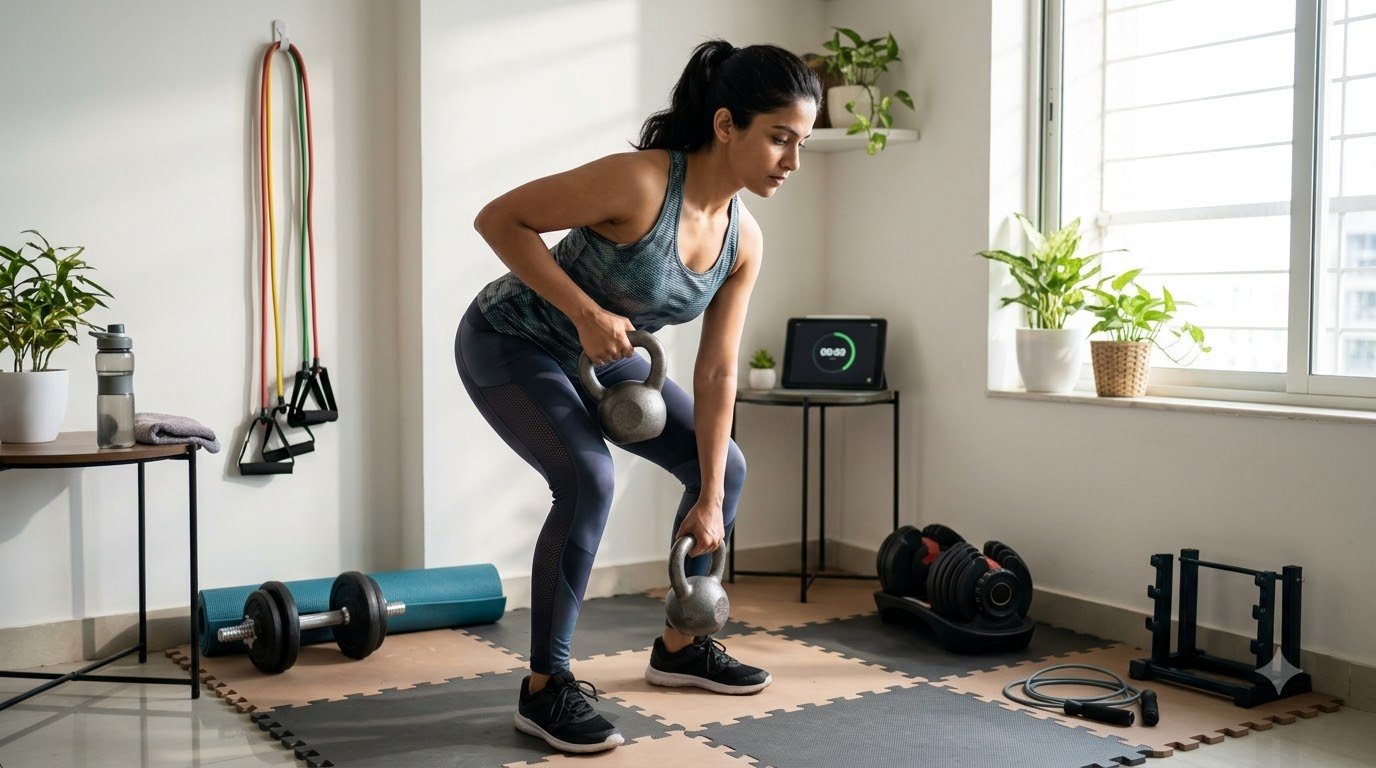
One of the biggest psychological hurdles of training at home is blurring the lines between relaxation and exertion. Your brain naturally associates your living room sofa with resting, watching television, or unwinding after a long workday. Trying to shift gears into an intense training mindset right next to your couch is remarkably difficult. To combat this, you must carve out a designated area dedicated entirely to your home gym routine.
Define Your Zone:
Even a small corner of a bedroom or a cleared-out section of a living room serves well as an active training zone.
Remove Friction:
Keep a yoga mat rolled out, stack your resistance bands nearby, and ensure the area stays free from household clutter.
Mental Transition:
When you step into your designated training zone, your brain immediately recognizes that it is time to work, making the mental shift automatic.
2. Apply Progressive Overload at Home Consistently
The single most common reason people fail to see physical changes from home gym workouts is a lack of progressive overload. Your muscles are remarkably smart, adaptive organs; they will only grow stronger, denser, and more toned if they are forced to handle physical demands that exceed what they are currently accustomed to. If you perform the exact same bodyweight squats week after week, your body adapts and flatlines.
Driving continuous progression at home involves strategic adjustments across several training variables:
Increase Repetitions:
If you completed 10 push-ups last week, aim for 11 or 12 this week.
Slower Tempos:
Introduce a 3-to-4-second eccentric (lowering) phase to dramatically increase time under tension.
Shorter Rest Periods:
Reduce rest time between sets from 90 seconds to 60 seconds to increase metabolic demand.
Advanced Exercise Variations:
Progress from knee push-ups to standard push-ups, or elevate your feet on a chair.
3. Centre Your Sessions on Powerful Compound Movements
When time, space, and equipment are limited, you cannot afford to waste energy on isolated, low-return exercises. If you want effective home training, your programming must be anchored around multi-joint compound movements. Compound exercises such as squats, push-ups, lunges, hip hinges, and overhead presses recruit multiple large muscle groups simultaneously.
By focusing on compound patterns, you maximize caloric burn, stimulate massive muscle recruitment, and build balanced, functional strength. Instead of spending twenty minutes doing isolated bicep curls, build your routine around deep squats, pike push-ups, and single-leg deadlifts using resistance bands or weighted backpacks.
4. Master Strict Form and Deep Muscle Control
In a commercial fitness facility, a certified personal trainer can quickly step in to correct posture mistakes. During home gym workouts, however, you act as your own coach and auditor. Sloppy repetitions performed at high speeds do not build muscle efficiently; instead, they invite joint irritation and strain.
Control the Eccentric:
Take your time lowering your body or weight against gravity to increase muscle fiber recruitment.
Brace Your Core:
Pay close attention to spine alignment and keep your abdominal core braced tightly throughout every repetition.
Mind-Muscle Connection:
Focus intentionally on feeling the target muscle stretch and contract. Perfect form with lighter loads always outperforms momentum-driven lifting.
5. Seamlessly Combine Strength and Cardio Elements
Many trainees make the mistake of viewing strength training and cardiovascular conditioning as two entirely separate activities. In the context of efficient home gym workouts, blending these two training modalities into a cohesive routine yields incredible metabolic results. You can structure sessions as high-intensity resistance circuits, moving rapidly from a lower-body strength movement into a dynamic conditioning drill.
Pairing bodyweight squats with controlled mountain climbers or alternating push-ups with steady movement keeps your heart rate elevated. This hybrid approach triggers excess post-exercise oxygen consumption (EPOC), meaning your body continues burning energy long after you finish training.
6. Never Skip a Thorough Warm-Up and Cool-Down
It is easy to view warm-ups as a waste of time when trying to squeeze a quick session into a packed schedule. However, skipping preparation is the fastest route to a sidelined injury. Cold muscles, stiff joints, and an unprepared nervous system cannot handle resistance safely.
Spend five to ten minutes on dynamic movements like arm circles, torso twists, dynamic lunges, and leg swings to elevate core temperature. Similarly, finish your session with a proper cool-down consisting of static stretches to lower heart rate and reduce muscle tension.
7. Protect Your Recovery and Guard Your Consistency
A common misconception is that working out seven days a week at maximum intensity yields faster results. In reality, muscles do not grow while you are actively working out; real tissue growth, repair, and strength adaptation occur exclusively outside the gym during rest, proper nutrition, and quality sleep. For a deeper dive into how rest drives progress, check out our guide on the importance of rest and recovery in fitness.
Build scheduled rest days directly into your weekly home fitness routine. Alternating intense training days with active recovery protects your joints and keeps your mental drive fresh. Showing up consistently 3 to 4 times a week for structured sessions always triumphs over erratic overtraining.
Ready to Take Your Fitness Beyond?
Home gym workouts are a fantastic starting point to build baseline discipline and stay active when life gets busy. However, as your strength increases, you may reach a plateau where you crave heavier free weights, specialized machinery, and the electric energy of a dedicated training community.
When you are ready to break through your plateaus and elevate your routine, the certified expert trainers at One More Rep Gym are here to guide you. Visit our state-of-the-art branches in Maroli or Mallikatte, enjoy our equipment environment, and let us help you achieve lasting physical change. You can also explore our inspirational transformation stories to see how structured training has helped members across Mangalore reach their goals, and read our tips on staying motivated when fitness gets tough if your drive ever slips!
Frequently Asked Questions (FAQs)
1. Are 30-minute home gym workouts actually effective?
Yes, absolutely. A focused 30-minute session utilizing compound exercises with minimal rest between sets can be exceptionally effective for building stamina and maintaining muscle mass.
2. Can you build significant muscle using only home gym workouts?
Yes, provided you apply progressive overload consistently. While heavy free weights in a commercial facility make hypertrophy easier, you can stimulate muscle growth at home by increasing reps, slowing tempos, or using resistance bands.
3. How can I make my home gym routine feel less distracting?
- Establish clear boundaries: Set up your training zone away from common areas and put your phone on silent before you start.
- Protect your mental focus: Treat your scheduled session with respect by avoiding household interruptions until your final set is complete.
- Use environmental cues: Keep your workout mat rolled out and equipment ready so the space signals work the moment you step into it.
4. How many days a week should I do home gym workouts?
For most individuals, training at home 3 to 5 days per week is the optimal balance for progress and recovery, ensuring your muscles get at least 48 hours to repair between intense sessions.
5. How do I measure progress without gym equipment?
- Maintain a training logbook: Write down every exercise, repetition count, and rest interval to track your physical performance accurately week by week.
- Test leverage variations: Adjust your body angles, hand placements, or foot elevations to make standard movements naturally more challenging over time.
- Control your execution speed: Slow down the lowering phase of every repetition to increase muscle tension without needing heavier weights.